Replacing a Lead Water Pipe: What It Costs, Who Pays and Whether You Need an Approved Plumber (2026)
What it costs to replace a lead water supply pipe in 2026, who owns and pays for which section, whether you need an approved plumber, and how the Thames Water lead pipe scheme works, including what to do while it is closed until spring 2027. UK prices first, then London, with a fair quote checklist and a worked sum.
Last updated: November 2026. Scheme details checked on 15 November 2026. Who owns which pipe comes from the water companies and their regulators; the prices come from dated UK market guides, because no official body publishes them. This guide is general information, not a quote and not medical advice.
TL;DR: You own the supply pipe from the outside stop valve inwards; the water company owns the rest, back to the main [1]. Replacing a lead supply pipe costs about £400 to £700 under a lawn and £1,500 to £3,000 or more under paving [11]. No law requires an approved plumber [20]. Thames Water's scheme is closed until spring 2027 [1].
A lead water pipe is usually two pipes, owned by two different parties. That is why the question "who pays?" matters as much as "how much?". This guide explains the ownership split first, then what the private part costs, whether you need an approved plumber, what a fair quote should list, and how the Thames Water scheme works, including what to do while it is closed.
Whose pipe is it?
The water that reaches your kitchen tap travels through two sections of pipe outside the house:
- The communication pipe runs from the water main, usually under the pavement or road, to the outside stop valve, which is normally at or near your property boundary. Thames Water says: "We own the communication pipe", which "starts at our water main and usually runs to the outside stop valve at your property boundary" [1].
- The supply pipe runs from that stop valve, under your front garden or path, into your home. Thames Water says: "You own the internal pipework and the supply pipe" [1].
The Consumer Council for Water (CCW), the statutory body for water customers, describes the same split: the water company is responsible for "Any pipes that connects the water main up to the point where is crosses your property boundary", and "The homeowner is responsible for maintaining any water pipes located on private property" [8].
So if your home has a lead supply, you pay to replace the supply pipe and any lead pipework inside, and the water company deals with the communication pipe. Thames Water's scheme page does not mention any charge to you for its section [1].
Shared supply pipes. Many older terraces share one supply pipe between two or more homes. Thames Water says: "Shared supply pipes are your and your neighbour's responsibility to maintain and replace", and that each household is responsible for any branch that feeds only its own home [1]. CCW says a shared pipe "becomes the joint responsibility of all property owners that are connected to it" [8]. Thames Water does not separate shared supplies under its lead scheme, but you can call it on 0800 009 3921 to discuss moving to a single supply [1]. In practice, agree the work, and the split of the cost, with your neighbours before anyone digs.
Flats. A block usually has one shared supply. If you are a leaseholder, your lease will say whether the pipe is the freeholder's responsibility or shared through the service charge, so check it before you commission anything.
Renting. If you rent, a lead pipe inside the home is usually your landlord's repair responsibility under section 11 of the Landlord and Tenant Act 1985, which requires them to keep "the installations in the dwelling-house for the supply of water" in repair and proper working order [7]. Who is responsible for the pipe outside depends on your tenancy and the property, so report a suspected lead pipe to your landlord in writing.
Not every home is supplied by Thames Water. Depending on where you live, your drinking water may come from a different company. Your water bill names your supplier. Schemes differ between companies (see below), so check your own supplier's terms before you plan the work.
What does it cost to replace a lead supply pipe in 2026?
There is no official price list. The figures below come from two 2026 market guides, and neither states whether VAT is included [10][11]. Use them to judge a quote, not to replace one.
| Job | Typical 2026 price | What drives it | Source |
|---|---|---|---|
| Short run under 8 m, moled under a lawn | £400 to £700 | Easy access, little to reinstate | Trade2Base, 14 Jun 2026 [11] |
| Typical front garden replacement | £450 to £1,500 or more | Length, path or paving to lift and relay | Trade2Base, 14 Jun 2026 [11] |
| Longer run under a drive, patio or landscaping | £1,500 to £3,000 or more | Breaking out and reinstating hard surfaces | Trade2Base, 14 Jun 2026 [11] |
| Whole supply pipe, UK average job | About £3,200 (about £1,200 to £4,400 or more) | Mostly the length of the run; 1 to 3 days | MyJobQuote, updated 7 Sep 2026 [10] |
| Open trench, priced per metre | £100 to £125 per metre | Ground conditions, depth, surface | MyJobQuote, updated 7 Sep 2026 [10] |
| No-dig (moling), priced per metre | £150 to £200 per metre | Avoids lifting a drive or tiled path | MyJobQuote, updated 7 Sep 2026 [10] |
| Mole hire and operator | £250 to £500 | Added where the pipe is pushed underground | Trade2Base, 14 Jun 2026 [11] |
| Add-on: break out and reinstate a 3 m concrete path section | £280, in one worked example | Hard surfaces the mole cannot pass under | Trade2Base, 14 Jun 2026 [11] |
| Add-on: lead pipework inside the home | £200 to £600 per home | How much lead runs inside, and access | Trade2Base, 14 Jun 2026 [11] |
These are market figures, not survey results. MyJobQuote builds its prices from quotes given by tradespeople on its own platform [10]. Trade2Base is a software firm's pricing guide for tradespeople and does not state its method [11]. Neither is an official source, and both show how much the price depends on the route of the pipe rather than the pipe itself.
Neither guide gives a price for splitting a shared supply into separate pipes, or for lifting and relaying a tiled or block-paved path. Ask for each as a separate line if it applies.
Do you need an approved plumber?
Not by law. WaterSafe, the national accreditation body for approved plumbers, says: "Customers are not legally obliged to use an approved plumbing business" [20]. It adds that, unlike gas engineers, no law currently requires plumbers to be on a recognised industry register [20].
Approval still matters for a lead supply pipe, for three reasons:
- The Thames Water scheme checks the work one of two ways. An approved plumber "will issue a certificate about the work they carried out", and no open trench inspection is needed, though you must email Thames Water the certificate. With an independent plumber, "the pipe laid within the open trench must be inspected by Thames Water", and "This must be done before burying" [1]. Thames Water says that without a passed survey or a certificate from an approved plumber, you cannot qualify [1].
- A certificate is your evidence. Under the Water Supply (Water Fittings) Regulations 1999, an approved contractor who installs or alters a water fitting must give the person who commissioned the work a signed certificate stating whether it complies [19]. WaterSafe says its Certificate of Compliance gives property owners a defence if a water supplier enforcing the regulations challenges the work [20].
- The depth of the pipe matters. Laying a water pipe outside a building at less than 750 mm or more than 1,350 mm below ground is one of the operations the regulations say must be notified to the water company before work starts, even by an approved contractor [5]. Thames Water's scheme asks for a trench between those depths [1].
Searching for a "Thames Water approved contractor"? Thames Water's lead pipe scheme page does not use that phrase. It links to the WaterSafe list of approved plumbers instead [1]. WaterSafe also lists water supply pipe installers, who are recognised by WIAPS, the water company approval scheme, to work on the supply pipe from the external stop tap up to the internal stop tap. WaterSafe says they "are not approved WaterSafe Register plumbers", so for pipework inside the home it advises an approved plumber who is approved for all types of plumbing work [20]. Thames Water also says any lead pipes or lead solder inside the home should be removed by an approved plumber [1].
Do not touch the communication pipe yourself: it belongs to the water company [1].
What a fair quote for a lead supply pipe should list
Citizens Advice says a quote should give a fixed total price rather than a daily rate, a breakdown of the work and materials with separate costs, how long the price is valid and whether it includes VAT [12]. For a lead supply pipe, a fair quote names each of these:
- The route and length: from the outside stop valve to where the pipe enters the house, measured, not guessed.
- The method: open trench or moling, and why.
- The pipe: the size and type. Thames Water's scheme expects 25 mm pipe or a like-for-like replacement [1].
- Inside the house: how far the new pipe runs, whether a new internal stop tap is fitted, and whether any lead pipework inside is replaced.
- Reinstatement: exactly which surfaces are relaid (lawn, concrete, paving, period tiles) and to what standard.
- Waste and spoil: whether the soil and old pipe are taken away.
- Water company paperwork: who applies to the scheme, and whether the plumber issues an approved certificate or books the open trench inspection.
- Basements and vaults: any wall breakthrough, which Thames Water says is the customer's responsibility [1].
- Shared supply: if neighbours are involved, what is included for each home.
- VAT: included, excluded, or not charged because the plumber is not VAT-registered.
- Parking, permits and timing: start date, expected days and any payment up front.
If a quote is a single figure with none of these, ask for the breakdown before you agree. Citizens Advice says to get written quotes from at least three different traders [12].
How the Thames Water lead pipe scheme works
If your water comes from Thames Water, its scheme is the main way to get the whole length renewed. This is how it works on the scheme page, checked on 15 November 2026 [1].
The scheme is closed until spring 2027. On 15 November 2026 the scheme page says: "Our lead replacement scheme is now closed. It will reopen in spring 2027" [1].
Who can apply. You must "Have a property built before 1970" and not be aware of Thames Water having replaced the communication pipe already [1]. You also need to have "located your outside stop valve and confirmed the supply arrangement", and to be "planning to replace your lead supply pipe within the next 3 months" [1]. After three months you need a new application [1].
What you replace. "The lead pipe replacement scheme is a like for like replacement" [1]. Your new pipe must come up to the outside stop valve or property boundary. Thames Water says "Existing smaller pipes (12-15mm) will be replaced with the industry standard sized pipes (25mm)", and that where the lead supply is wider than 25 mm, it will match the current diameter [1].
Approved or independent plumber. You choose. An approved plumber's certificate replaces the trench inspection; with an independent plumber, Thames Water inspects the pipe in the open trench before it is buried [1]. See the section above on approved plumbers.
What Thames Water then does. It aims "to complete the replacement within three months from qualifying", and "The reinstatement works usually take place within two working days after the replacement" [1]. The job is complete once the communication pipe and the road have been reinstated [1].
What to do while the scheme is closed
The closed months are a good time to prepare, so you are ready when applications reopen:
- Confirm the pipe is lead (see the checks below), and find your outside stop valve.
- Find out whether the supply is shared, and talk to the neighbours if it is.
- Get three itemised quotes using the checklist above, and decide whether you want an approved plumber.
- Plan the timing so the work can start within three months of your application.
- Follow your water company's advice on running the tap in the meantime (see below).
You can still have your supply pipe replaced by a competent plumber while the scheme is closed. The catch is that the communication pipe stays lead until the scheme reopens and you qualify. Thames Water's eligibility list includes being able to "supply photographic evidence the pipe has been replaced in the past" [1], so keep photos of the open trench and the new pipe, and ask Thames Water how it would treat your case before you commit.
Thames Water's wider programme is set by its regulator. A Drinking Water Inspectorate (DWI) notice signed on 10 February 2026 records Thames Water "targeting 54,000 lead communication pipe replacements" by 31 March 2030 [3].
Other water companies in the UK
Schemes vary a lot, and some are by invitation only. These are the terms each company's page showed on 15 November 2026:
- United Utilities (North West England): you "may be eligible to apply for a grant of £550 towards the services of a private plumber", plus "a free 25mm connection of a replacement water supply pipe, from your boundary to the water main in the road or footpath", if you replace "all pipework within your property boundary up to the first cold water tap" [15]. The page does not say whether the scheme is currently open.
- Yorkshire Water says "we'll test a sample of your water for free", and "if the pipe supplying your home is made from lead, we'll replace our bit for free as well". You are responsible for the lead pipe inside your boundary, and it asks you to wait for its reply to your application before arranging any work [16].
- Essex & Suffolk Water is replacing lead pipes in specific neighbourhoods. It says "This work is funded by Essex & Suffolk Water", but only invited homes can book, subject to a survey [17].
- Severn Trent closed its supply pipe grant trial: "Applications for this scheme have now closed" [18].
For any other company, check that company's own lead page. Do not assume the Thames Water rules apply.
Do you have lead pipes? What the water authorities say
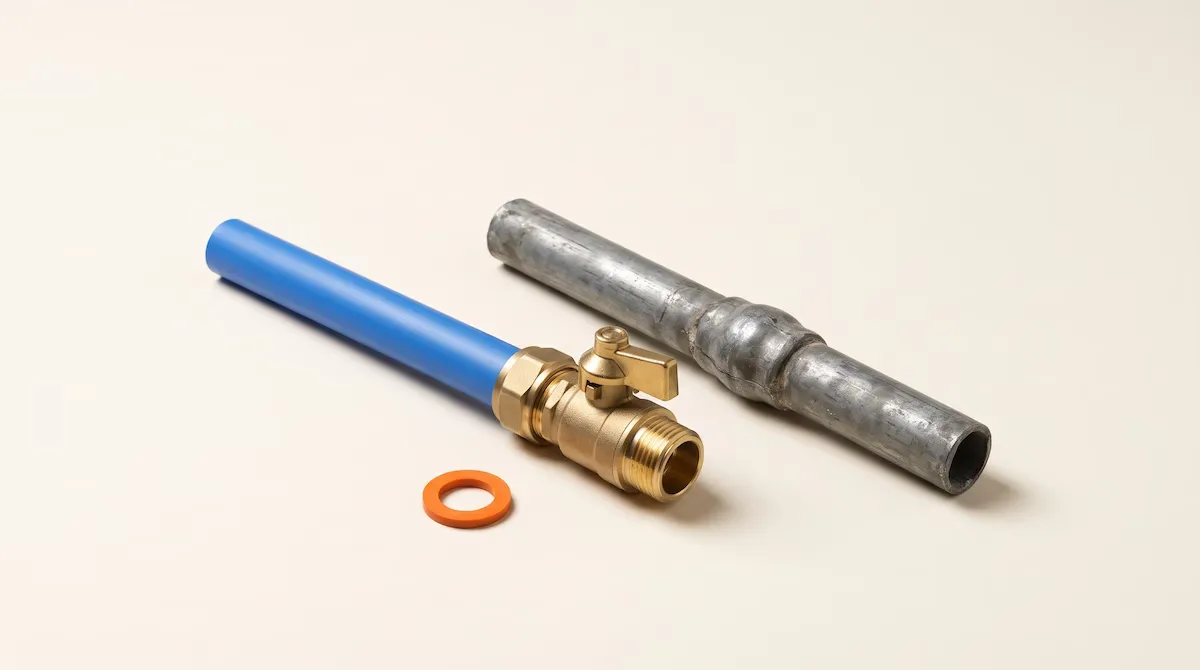
How to tell. UK Health Security Agency (UKHSA) guidance says: "If your home was built before 1970 it may have lead pipes" [9]. Look at the pipe where it comes in, often near the internal stop tap, which may be in or behind a kitchen cupboard. The DWI says: "Unpainted lead pipes appear dull grey and often have a swollen joint next to the tap" [4]. Thames Water adds that "Scratches on lead pipes will reveal a shiny metal that's silver in colour", and that "Lead makes a dull thud" when tapped [2]. The DWI advises wearing disposable gloves and not breathing in any dust if you scrape a pipe [4]. If you are unsure, ask a plumber to look.
The limit. The legal limit for lead at consumers' taps in England is 10 micrograms per litre, under the Water Supply (Water Quality) Regulations 2016 [6]. Thames Water says there is "virtually no risk to health from the levels of lead allowed in drinking water", but that the Department of Health recommends trying to reduce lead levels further [2].
Who the authorities single out. UKHSA says: "Pregnant women, infants and young children are particularly sensitive to the harmful effects of lead" [9]. The DWI names infants, including unborn babies, and children [4].
What the water companies advise until the pipe is replaced. Thames Water says: "Run your kitchen tap for two minutes in the mornings or if you've been away for a few days" [2]. It also says to use only the cold kitchen tap for drinks and food, and that boiling water does not help [2]. The DWI says that "A washing up bowl full is normally enough to clear the pipe of standing water" [4].
Testing. The DWI says: "If you suspect that your home has lead pipes you can ask your water company to test the water at your kitchen tap" [4]. Thames Water says it can collect samples if you call 0800 316 9800 [2]; its page does not say whether there is a charge, so ask.
Your health. This guide cannot advise on health. If you are worried about lead and your health, UKHSA says to seek guidance from your GP or contact NHS 111 [9].
After the work. The DWI advises: "Flush the tap well for at least 10 minutes after carrying out any work on a lead pipe" [4]. Thames Water says that on the first day after its replacement is complete, you should run all taps used for drinking or cooking for 10 minutes [1].
A worked sum: a terraced house with a concrete path
This is an illustration built from the rates cited in this guide. It is not a quote and not a real job. It assumes a terraced house with a 7 m supply pipe laid in an open trench under the front garden, crossing a 3 m concrete path, with 25 mm pipe, a new stop tap, about 2 m of lead replaced inside, and Thames Water renewing its communication pipe through the scheme once it reopens.
| Line | Basis | Illustrative cost |
|---|---|---|
| Open trench and lay the pipe | 7 m at £100 to £125 per metre [10] | £700 to £875 |
| Break out and reinstate the concrete path | Trade2Base worked-example line for a 3 m concrete path section [11] | £280 |
| 25 mm pipe, fittings, duct and stop tap | Trade2Base worked-example materials line [11] | £140 |
| Through the wall, replace about 2 m of lead inside, connect | Trade2Base worked-example internal line [11] | £220 |
| Communication pipe | Thames Water's part [1] | No charge to you shown on its scheme page |
| Total before VAT | About £1,340 to £1,515 | |
| Total if the plumber charges VAT at 20% | About £1,610 to £1,820 |
MyJobQuote does not say whether its per-metre rate includes the pipe, so the materials line may overlap with the first line. For comparison, Trade2Base's own worked example, an 11 m run moled under a lawn with a 3 m concrete path, totals £1,420 [11]. A tiled Victorian path, a basement entry, more lead inside or a shared supply would push the cost up, and none of these guides prices relaying a tiled path, so ask for it as its own line. Moling at £150 to £200 per metre [10] costs more per metre but can avoid lifting most of a path.
What pushes London prices up
MyJobQuote says prices in London and the South East "are usually higher than in other parts of the UK" [10]. Trade2Base puts a two-person gang at £350 to £550 a day in most of the country and £500 to £750 a day in London and the South East [11]. Neither gives a London figure per metre.
Things that raise London quotes:
- Period front paths. Victorian and Edwardian tiled paths take time to lift and relay, and none of the guides above prices that work.
- Basements and vaults. Where the pipe runs into a basement, Thames Water says the customer is responsible for wall breakthroughs [1].
- Parking and access. Paid parking, permits and skips add cost on busy streets.
- Shared supplies. Common in terraces and converted houses, and they need everyone to agree.
Leaks on the supply pipe: who pays?
The same ownership split applies to leaks. A leak on the supply pipe inside your boundary is yours to fix, and a leak on the communication pipe or the main is the water company's [1][8]. If water is coming up through your front garden and you are not sure which side it is on, contact your water company first.
If a lead pipe is leaking, that is often the moment to replace it rather than patch it. For an urgent leak, see what an emergency plumber costs, and for cold snaps, read what to do about frozen or burst pipes, which also explains how to find and use your stop tap.
Do plumbers charge VAT on this work?
Only if they are VAT-registered. A business must register once its taxable turnover over the last 12 months goes over £90,000 [13], so many sole-trader plumbers do not charge VAT. Where it applies, the standard rate is 20% [14]. Neither market guide above states whether its figures include VAT [10][11], so ask every plumber to say clearly.
How to choose a plumber for a lead pipe
- Check approval yourself. If a plumber says they are WaterSafe approved, check the WaterSafe register rather than relying on a logo [20].
- Get at least three written quotes, itemised as in the checklist above [12].
- Keep any deposit small. Citizens Advice says not to agree to more than 25 per cent [12]. Our guide to how much deposit to pay a tradesperson explains why.
- Agree the reinstatement in writing, especially for tiled or paved paths.
- Know your rights if it goes wrong. Our guide to what to do if a tradesperson does a bad job sets out the steps.
If you are planning other plumbing at the same time, such as a new bathroom or a new shower, it can be worth asking the same plumber to price the supply pipe too. For more on vetting anyone who works in your home, read how to find a trusted tradesperson.
Finding a plumber for a lead pipe
Loacally is launching in London first, so customer coverage is starting there, with more of the UK to follow. If you live elsewhere you cannot book through Loacally yet, though the ownership rules, prices and quote checklist here still apply.
In London, our plumbers page shows who covers your area and what each plumber lists. Replacing an outside supply pipe means digging, and not every plumber takes that work, so check the services on a profile and confirm in your message that they take this kind of job, and whether they are WaterSafe approved, before you book. Start with a clear brief: the age of the house, where the outside stop valve is, the route and length of the pipe, what the path is made of, and whether the supply is shared.
Each service on a Loacally profile shows a starting price or says it is quoted on a visit. Every member is reviewed by hand before their profile goes live. Loacally does not set prices or take payment, and it does not inspect work or hold insurance documents, so ask to see proof of insurance before work starts, and check any approval on the WaterSafe register yourself. You can also find local tradespeople near you.
Frequently asked questions
Who pays to replace a lead water pipe?
You pay for the supply pipe, from the outside stop valve into your home, and any lead pipework inside. Your water company is responsible for the communication pipe from the main to that valve [1][8]. If you rent, your landlord is usually responsible for water installations indoors under section 11 of the Landlord and Tenant Act 1985 [7].
Does Thames Water replace lead pipes for free?
Thames Water owns the communication pipe and renews it through its scheme when you replace your own lead supply pipe in a home built before 1970 [1]. Its scheme page does not mention a charge for its section, but you pay for yours. The scheme is now closed and will reopen in spring 2027 [1].
How much does it cost to replace a lead supply pipe?
A short run under a lawn typically costs about £400 to £700, and a longer run under a drive or paving £1,500 to £3,000 or more, on a June 2026 market guide [11]. Another 2026 guide puts the average job at about £3,200, or £100 to £125 per metre of open trench [10]. London prices are usually higher [10].
Do I need an approved plumber to replace a lead pipe?
Not by law: WaterSafe says customers are not legally obliged to use an approved plumbing business [20]. On the Thames Water scheme, an approved plumber's certificate means no trench inspection is needed. With an independent plumber, Thames Water must inspect the pipe in the open trench before it is buried [1]. Check any approval claim on the WaterSafe register.
How do I know if I have lead pipes?
If your home was built before 1970, it may have lead pipes [9]. Look where the pipe comes in, often near the internal stop tap. The DWI says unpainted lead pipes "appear dull grey and often have a swollen joint next to the tap" [4]. A scratch shows shiny silver metal, and tapping gives a dull thud [2].
What should I do about drinking water until the pipe is replaced?
Follow your water company's advice. Thames Water says to run the kitchen tap for two minutes in the morning or after time away, and to use only the cold kitchen tap for drinks and food [2]. Your water company can test your water [4]. For health worries, UKHSA says to see your GP or contact NHS 111 [9].
Sources
- Thames Water - Lead pipe replacement (scheme status and terms, ownership, shared supplies) - https://www.thameswater.co.uk/help/water-and-waste-help/water-quality/lead-pipe-replacement - no page date shown, checked 15 November 2026.
- Thames Water - Lead (identifying lead pipes, running the tap, samples) - https://www.thameswater.co.uk/help/water-and-waste-help/water-quality/lead - no page date shown, checked 15 November 2026.
- Drinking Water Inspectorate - Thames Water Utilities Limited AMP8 Lead Strategy (notice TMS-2023-00013) - https://dwi.gov.uk/water-companies/improvement-programmes/thames-water-improvement-programmes/tms-2023-00013-v1/ - signed 10 February 2026.
- Drinking Water Inspectorate - Lead in drinking water - https://www.dwi.gov.uk/lead-in-drinking-water - no page date shown, checked 15 November 2026.
- legislation.gov.uk - The Water Supply (Water Fittings) Regulations 1999, regulation 5 and its table of notifiable operations - https://www.legislation.gov.uk/uksi/1999/1148/regulation/5 - checked 15 November 2026.
- legislation.gov.uk - The Water Supply (Water Quality) Regulations 2016, Schedule 1 - https://www.legislation.gov.uk/uksi/2016/614/schedule/1 - checked 10 November 2026.
- legislation.gov.uk - Landlord and Tenant Act 1985, section 11 - https://www.legislation.gov.uk/ukpga/1985/70/section/11 - checked 10 November 2026.
- Consumer Council for Water (CCW) - Who is responsible for my water pipes? - https://www.ccw.org.uk/faq/who-is-responsible-for-my-water-pipes/ - no page date shown, checked 15 November 2026.
- UK Health Security Agency, Gov.uk - Lead: information for the public - https://www.gov.uk/government/publications/lead-poisoning-advice-for-the-public-and-healthcare-professionals/lead-information-for-the-public - published 8 October 2024, checked 15 November 2026.
- MyJobQuote - Water supply pipe replacement cost (a quotes platform; prices from quotes on its own platform; VAT basis not stated; used for price context only) - myjobquote.co.uk/costs/water-supply-pipe-replacement - last updated 7 September 2026, checked 15 November 2026.
- Trade2Base - Lead pipe replacement costs UK (a software firm's pricing guide for tradespeople; method and VAT basis not stated; used for price context only) - https://www.trade2base.com/blog/lead-pipe-replacement-costs-uk - 14 June 2026, checked 15 November 2026.
- Citizens Advice - Before you get building work done - https://www.citizensadvice.org.uk/consumer/getting-home-improvements-done/before-you-get-building-work-done/ - checked 15 November 2026.
- Gov.uk - When to register for VAT - https://www.gov.uk/vat-registration/when-to-register - checked 10 November 2026.
- Gov.uk - VAT rates - https://www.gov.uk/vat-rates - checked 10 November 2026.
- United Utilities - Lead pipe replacement scheme - https://www.unitedutilities.com/help-and-support/your-water-supply/your-pipes/lead-pipes/lead-pipe-replacement-scheme - no page date shown, checked 15 November 2026.
- Yorkshire Water - Lead in Yorkshire's water - https://www.yorkshirewater.com/your-water/drinking-water-standards/lead-in-yorkshires-water/ - no page date shown, checked 15 November 2026.
- Essex & Suffolk Water - Lead pipe replacement - https://www.eswater.co.uk/leadreplacement - no page date shown, checked 15 November 2026.
- Severn Trent - Green Recovery grant scheme - https://stwater.co.uk/wonderful-on-tap/green-recovery/supply-pipes/green-recovery-grant-scheme - no page date shown, checked 15 November 2026.
- legislation.gov.uk - The Water Supply (Water Fittings) Regulations 1999, regulation 6 (contractor's certificate) - https://www.legislation.gov.uk/uksi/1999/1148/regulation/6 - checked 15 November 2026.
- WaterSafe Register - WaterSafe Register FAQs (legal position, Certificate of Compliance, water supply pipe installers) - https://www.watersafe.org.uk/about/information_for_customers/watersafe_faqs/ - no page date shown, checked 15 November 2026.
Need a plumber in London?
See who’s nearby, compare clear prices, and book a visit in minutes.
Keep reading
How Much Does It Cost to Replace a Hot Water Cylinder? 2026 UK and London Prices
What it costs to replace a hot water cylinder in 2026: a like-for-like vented swap, unvented supply and fit, and cylinder prices by size. UK prices first, then London, with a fair quote checklist, a worked sum, the Building Regulations and competent person rules, and VAT.
How Much Does a Walk-In Bath Cost? 2026 UK Prices, Fitting and VAT Relief
What a walk-in bath costs in 2026, by type: compact, standard, bath-and-shower and powered. UK prices first, then what is known about London, with a fair quote checklist, a worked sum, VAT relief for disabled and older people, Disabled Facilities Grants and your cancellation rights.
How Much Does a Walk-In Shower Cost? 2026 UK and London Prices, Including Replacing a Bath
What a walk-in shower costs in 2026, by job: a low tray in place of a bath, a tiled level-access floor or a full wet room. UK prices first, then London, with a fair quote checklist, a worked sum, VAT relief, Disabled Facilities Grants and Part P.