How Much Does Underfloor Heating Cost in London? (2026 Prices)
Underfloor heating costs roughly £40 to £120 per m² for electric systems and £85 to £190 per m² for wet systems in London in 2026. Compare electric vs wet prices, running costs, the safety rules on who can legally fit it, and how to judge a fair quote from a trusted local heating engineer.
Last updated: September 2026. London prices are market observations, since no official body publishes a London rate; the regulatory, efficiency and VAT facts are drawn from the Energy Saving Trust, Gov.uk, the Planning Portal (Approved Document P), Gas Safe Register and legislation.gov.uk. See the Sources list at the end.
TL;DR Underfloor heating in London costs roughly £40 to £120 per square metre for electric systems and £85 to £190 per square metre for wet (water) systems, supplied and fitted in 2026. A small electric bathroom runs about £240 to £480; a whole-floor wet retrofit is commonly £6,000 to £13,000. Wet systems cost more to fit but less to run.
Underfloor heating has moved from a luxury add-on to a mainstream choice for London bathrooms, kitchen extensions and whole-house refurbishments. This guide sets out what it costs in 2026, how electric and wet systems differ on both price and running cost, what a fair quote should itemise, and the safety rules that decide who is legally allowed to do the work.
How much does underfloor heating cost in London?
Underfloor heating (UFH) is priced per square metre of floor covered, so the size of the room drives the bill more than the brand of the kit. In 2026, electric UFH typically costs £40 to £120 per square metre supplied and installed, with most jobs landing in a £60 to £100 band. Wet UFH, which circulates warm water through pipes, typically costs £85 to £190 per square metre, with new-build work at the lower end and retrofits at the top.
No regulator publishes an official London price, so treat these figures as an informed market observation. London labour rates, travel time, congestion charging and parking tend to push quotes above the national average, and a retrofit into an existing room always costs more per square metre than the same system laid in a new extension, because the old floor has to be lifted and made good.
Fair quote checklist: what a good underfloor heating quote itemises
Underfloor heating is buried under your finished floor, so a mistake is expensive to reach. A trustworthy London installer will put every one of these in writing before any money changes hands, because the Consumer Rights Act 2015 already treats a service contract as including a term that the work is done with reasonable care and skill [5]. A clear, fixed quote is what gives you something to hold them to.
- System type stated plainly: electric mat or cable, or wet pipework with a manifold, and why that choice suits your room.
- The full floor build-up: insulation boards, the heating layer, and the screed or self-levelling compound depth, so you know how much height the floor will gain.
- Controls included: thermostat, floor sensor and any zone controls, listed as part of the price rather than an afterthought.
- What is excluded: the floor covering (tile, luxury vinyl or engineered wood), any consumer-unit upgrade, and any boiler or heat-source work are usually separate.
- Screed product and drying time: a legitimate quote names the screed and its expected drying time, not just an installation date.
- The regulatory route: for electric UFH, the Part P notification and compliance certificate [3]; for wet UFH tied to a gas boiler, the Gas Safe registered engineer who will make the connection [4].
- VAT position in writing: standard 20 per cent normally applies, so ask which elements, if any, qualify for relief (see the VAT section) [2].
Underfloor heating cost by scenario (2026)
The scenario matters more than the label on the box. The table below shows typical 2026 London figures. Every price is supplied and fitted, and excludes the floor covering itself.
| Scenario | System usually used | What it typically includes | Indicative price (2026) |
|---|---|---|---|
| Small bathroom or en-suite (around 4m²) | Electric mat or cable | Mat or cable, thermostat, floor sensor, insulation underlay | £240 to £480 |
| Kitchen-diner (around 10 to 15m²) | Electric or entry-level wet | Heating layer, controls; wet adds pipework and manifold connection | £900 to £1,800 (electric) |
| Whole-floor retrofit (80 to 120m² house) | Wet, screed or low-profile overlay | Manifold, pipework, insulation, screed, room thermostats, commissioning | £6,000 to £13,000 |
| New extension or new-build | Wet, standard screed | Pipework, manifold, insulation, screed poured as part of the build, controls | £85 to £100 per m² |
Two things drive the spread. First, electric is the practical choice for a single small room because the floor only gains 15mm to 25mm of height and the job is quick, whereas wet is the standard for whole floors and new builds because it is far cheaper to run at scale. Second, the electric bathroom figures assume the electrical circuit already exists; if an electrician has to run a new spur and fit protection, that is extra (see the safety section). For a wider view of how these numbers sit against other trades, see the London trade costs index.
Electric vs wet underfloor heating: which should you choose?
The choice between electric and wet UFH is the single biggest decision on cost, and it usually comes down to how big the area is and whether the floor is being built from scratch.
Electric (also called dry) UFH uses heating mats or cables that warm up when electricity passes through them. The Energy Saving Trust describes it as effective for quickly warming small areas, such as providing comfort underfoot in a bathroom, but notes it "can be costly to run over longer periods or in larger spaces" [1]. It is cheap to fit, thin enough to retrofit under a new tiled floor, and ideal for a bathroom, en-suite or small kitchen.
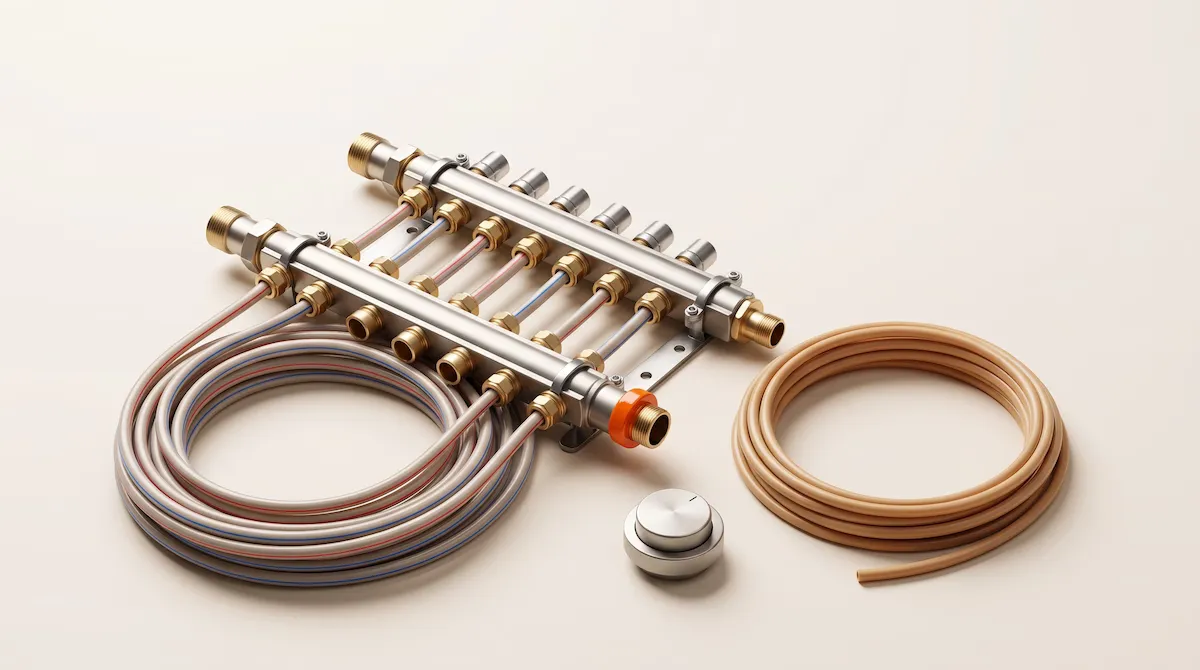
Wet (also called hydronic) UFH runs warm water through pipes connected to your boiler or heat pump. Because the heated surface is so much larger than a radiator, the Energy Saving Trust explains that a wet system can heat your home "at lower boiler or heat pump flow temperatures, which will help save money on your energy bills compared to only using radiators" [1]. It costs more to install, especially as a retrofit, but is the sensible choice for a whole floor, a large extension or any home aiming for lower long-term running costs. If you are already weighing up your heat source, our guides to new boiler costs in London and radiator replacement costs sit alongside this decision.
What drives the price up or down
Beyond the electric-versus-wet split, a handful of factors move a UFH quote:
- Floor build-up height and screed depth. Traditional wet UFH needs roughly 50mm to 65mm of screed over the insulation, while liquid screed can be thinner and low-profile retrofit systems as little as 15mm to 25mm. In a retrofit, door clearances and skirting boards are already fixed, so a low-profile system that saves height often costs more per square metre but avoids expensive joinery.
- Insulation. Insulation boards under the pipes or mat are near-universal, because without them a large share of the heat is lost downward into the subfloor rather than up into the room. Floor insulation quality is repeatedly flagged as the biggest driver of running-cost outcomes.
- Heat-source compatibility. Wet UFH works best at low flow temperatures, so connecting into an older, hotter boiler system may need a blending valve or mixing manifold to bring the water down to a safe floor temperature, which adds cost.
- Floor covering. Tile and stone conduct heat well and are the best-performing coverings; engineered wood and luxury vinyl are usually fine within the manufacturer's thermal limits; thick carpet with a high-tog underlay can throttle the heat output and may force a higher-output design. If you are tiling over UFH, our bathroom tiling cost guide covers the finishing layer.
- Access and making good. Retrofits carry the extra cost of lifting and disposing of the old floor, adjusting door heights and making good thresholds, which is why retrofit prices per square metre always sit above new-build.
Is underfloor heating cheaper to run than radiators?
Underfloor heating can be cheaper to run than radiators, but only under the right conditions, and the system type matters more than the marketing. The mechanism is flow temperature: UFH spreads heat across the whole floor, so it warms a room at around 45C, well below the 60C to 70C that radiators typically need. Running the heat source cooler is where any saving comes from, and it holds regardless of what energy costs at any given moment [1].
That saving is real for wet UFH and largely theoretical for electric. The Energy Saving Trust is clear that a wet system run at lower flow temperatures can save on bills compared with using radiators alone, while electric UFH is better seen as comfort or top-up heating for small rooms than as a cheap way to heat a whole house [1]. Wet UFH also pairs well with a heat pump, which is at its most efficient at low flow temperatures, though the efficiency gain only materialises with good floor insulation beneath the pipes.
One honest caveat on numbers: running costs depend entirely on your tariff, so avoid any headline annual figure that does not state the energy price behind it. For a live calculation, use the Energy Saving Trust's guidance or your own supplier's unit rate rather than a figure baked into a cost guide.
Underfloor heating regulations: who is legally allowed to fit it?
Underfloor heating is not a job to hand to just anyone, because both main types touch regulated safety work. This is the part of the quote where corners cost the most.
Electric UFH is notifiable electrical work. Installing electric UFH means installing a new electrical circuit, which is notifiable under Part P of the Building Regulations in England, and work in a bathroom is a special location where the rules are stricter still [3]. There are two lawful routes: use an electrician registered with a competent-person scheme such as NICEIC, NAPIT or ELECSA, who can self-certify and notify building control on your behalf, or notify your local authority building control directly and have the work inspected. Insist on a compliance certificate on completion, and never accept "no certificate needed" for a new circuit. Our guide to EICR electrical safety certificates in London explains how electrical compliance is documented.
Wet UFH tied to a gas boiler needs a Gas Safe registered engineer. The pipework, manifold and screed are heating-engineer work, but the final connection into a gas boiler must be made by a Gas Safe registered engineer, which is a legal requirement overseen by the Health and Safety Executive, not a voluntary badge [4]. Ask to see the engineer's Gas Safe ID card, front and back, and verify the number on the Gas Safe Register before work starts [4]. If your wet UFH is fed by a heat pump rather than a gas boiler, the Gas Safe rule does not apply, but the electrical work for the heat pump will usually still be notifiable under Part P [3].
TrustMark and grants. TrustMark is the only government-endorsed scheme covering work in and around the home, spanning plumbing, heating and energy-efficiency work [6]. A standalone UFH job does not legally require it, but if your installation is part of a heat-pump project claiming a government grant, TrustMark and MCS registration are effectively required for eligibility, and TrustMark is a reliable trust filter either way.
Does underfloor heating qualify for reduced VAT?
Do not assume underfloor heating is VAT-free. Between 1 May 2023 and 31 March 2027, the installation of qualifying energy-saving materials carries a zero VAT rate, reverting to 5 per cent from 1 April 2027 [2]. However, Gov.uk's list of qualifying materials covers insulation and heating controls such as thermostats and timers; it does not explicitly list underfloor heating pipework or electric heating mats [2].
In practice, this means the insulation boards and thermostatic controls within a UFH job may separately qualify for relief if a VAT-registered installer itemises them correctly, but the core UFH pipework or mat and its installation labour is not a listed material, so standard 20 per cent VAT normally applies to most of the job [2]. If the UFH is bundled into a larger renovation such as a full bathroom refit, the whole job is usually charged at the standard rate [7]. Ask your installer to confirm the VAT treatment in writing rather than assuming a relief applies.
How long does underfloor heating take to install?
Active installation is quicker than most homeowners expect; the wait is the floor drying, not the labour. A whole-house wet retrofit typically takes three to five days of on-site work to lay the pipework and manifold, while a low-profile overlay kit with no major screed can be done in one to two days. Electric mats in a single bathroom are often a one-day job.
The screed is where patience is needed. Traditional cement screed dries slowly, and trade guidance treats around four weeks as a sensible practical minimum before flooring goes down over a standard depth, though liquid screed dries far faster and can be ready in days. Crucially, screed readiness should be confirmed by a moisture test, not judged by time or appearance alone, because laying flooring or firing the heating too early is a common cause of cracked tiles and failed adhesive. A good quote states the screed product and its expected drying time so there are no surprises. If UFH is one part of a wider project, our bathroom renovation cost guide shows how the timeline fits the whole job.
Frequently asked questions
How much does underfloor heating cost in London in 2026?
Electric underfloor heating typically costs £40 to £120 per square metre supplied and fitted in London, and wet systems £85 to £190 per square metre. A small electric bathroom runs about £240 to £480, while a whole-floor wet retrofit is commonly £6,000 to £13,000. London prices sit above the UK average because labour rates are higher.
Is electric or wet underfloor heating cheaper?
Electric underfloor heating is cheaper to install, especially in a single small room, because it is thin and quick to fit. Wet underfloor heating costs more to install but is significantly cheaper to run over larger areas, so it wins for whole floors, extensions and new builds. Electric suits bathrooms; wet suits whole homes.
Is underfloor heating cheaper to run than radiators?
Wet underfloor heating can be cheaper to run than radiators because it heats a room at a lower flow temperature, around 45C against the 60C to 70C radiators need [1]. The saving only materialises with good floor insulation. Electric underfloor heating is generally costlier to run and is best used for small areas or comfort heating.
Do I need building regulations approval for underfloor heating?
Electric underfloor heating involves a new electrical circuit, which is notifiable under Part P of the Building Regulations in England, especially in a bathroom [3]. Use an electrician registered with NICEIC, NAPIT or ELECSA, or notify building control directly, and get a compliance certificate. Wet systems connected to a gas boiler need a Gas Safe registered engineer [4].
How long does underfloor heating take to install?
Laying the system takes one to two days for a low-profile retrofit or single bathroom, and three to five days for a whole-house wet system. The longer wait is the screed drying, which can be around four weeks for traditional cement screed but only days for liquid screed. Always have screed moisture-tested before flooring is laid.
Find a trusted heating engineer in London
Underfloor heating rewards getting the specification right first time, because it sits under a finished floor that is expensive to lift. Decide between electric and wet based on the room and your running-cost priorities, insist on the right registered tradesperson for the safety-critical work, and get a written, itemised quote you can hold to.
When you are ready to compare options, find a trusted local tradesperson on loacally. Every Loacally member is reviewed by hand before their profile goes live and sets out their services and coverage area, so you can see who actually works your part of London. For help judging any trade quote, see our guide to finding a trusted tradesperson in London.
Sources
- Underfloor heating -- Energy Saving Trust, accessed 2026-09-08
- Energy-saving materials and heating equipment (VAT Notice 708/6) -- Gov.uk, accessed 2026-09-08
- Approved Document P: Electrical safety - Dwellings -- Planning Portal (Building Regulations), accessed 2026-09-08
- Check an engineer -- Gas Safe Register, accessed 2026-09-08
- Consumer Rights Act 2015, Section 49 -- legislation.gov.uk, accessed 2026-09-08
- Who is TrustMark -- TrustMark, accessed 2026-09-08
- VAT for builders: energy saving and mobility -- Gov.uk, accessed 2026-09-08
Find a trade in London.
See who’s nearby, compare clear prices, and book a visit in minutes.
Keep reading

Why Does My Boiler Keep Losing Pressure? What to Do (2026)
A boiler that keeps losing pressure usually has a leak, a worn pressure relief valve or a failed expansion vessel. This 2026 guide explains what your pressure should be, how often topping up is normal, what you can safely check yourself, when to call a Gas Safe registered engineer, and what the repair typically costs in London.
Why Is My Radiator Not Heating Up? Causes, Fixes and When to Call a Plumber (London, 2026)
A cold radiator in a London home is usually easy to diagnose once you read the cold pattern. This 2026 guide explains what trapped air, sludge and valve faults look like, which fixes are safe to do yourself, what a plumber should charge to sort the rest, and when the job legally needs a Gas Safe registered engineer.

Frozen or Burst Pipes in London: What to Do and How to Prevent Them (2026)
A burst pipe in a London home is a race against the water. This 2026 guide gives you the emergency steps in order, how to thaw a frozen pipe safely, how to prevent freezing over winter, who is responsible when you rent or own a leasehold flat, and when to call a WaterSafe or Gas Safe registered professional.