Why Does My Boiler Keep Losing Pressure? What to Do (2026)
A boiler that keeps losing pressure usually has a leak, a worn pressure relief valve or a failed expansion vessel. This 2026 guide explains what your pressure should be, how often topping up is normal, what you can safely check yourself, when to call a Gas Safe registered engineer, and what the repair typically costs in London.
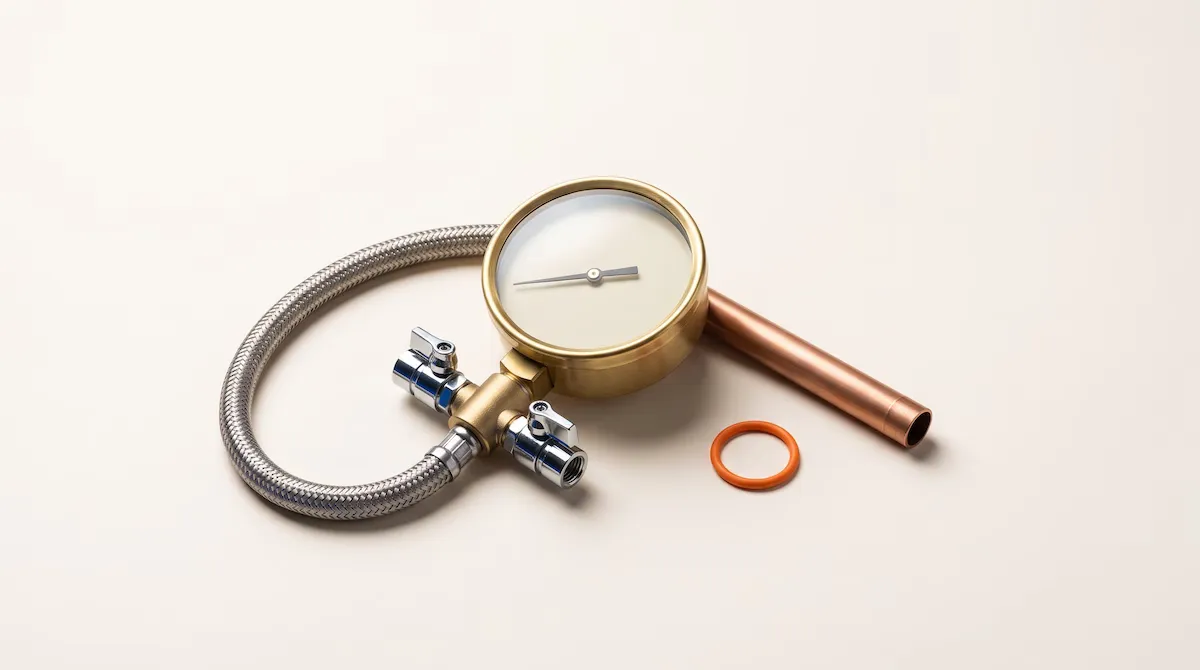
Last updated: October 2026
When the heating comes back on in autumn, one of the most common things London households notice is a boiler pressure gauge that has slipped into the low zone, or a combi that keeps showing a low-pressure fault however often it is topped up. A single drop is usually nothing to worry about. A boiler that keeps losing pressure is telling you something specific, and this guide explains how to read it, what you can safely check yourself, what a Gas Safe registered engineer needs to fix, and roughly what that costs in London.
TL;DR
A boiler that keeps losing pressure almost always has one of three faults: a leak somewhere in the heating system, a worn pressure relief valve dripping through the pipe outside, or an expansion vessel that has lost its air charge. Topping up once or twice a year is normal. Needing it more often means call a Gas Safe registered engineer.
What your boiler pressure should be
A combi boiler's normal pressure is about 1 to 1.5 bar when the heating is off, rising to about 2 bar when the system is hot. Which? puts it simply: "For combi boilers, your boiler pressure should sit somewhere between 1 and 2 bars" [1], and when the boiler is off the reading "should usually be around 1 or 1.5 bars" [1]. Vaillant gives the same picture, saying the gauge "will usually sit between 1 and 2 bars when it is turned on" [6].
A small rise and fall is normal. Water expands as it heats, so Vaillant notes that boiler pressure "will rise when it heats water in the system and drop slightly as it cools" [6]. What is not normal is a reading that falls steadily over days or weeks, or one that swings sharply between cold and hot.
The exact figures are model-specific, so check the markings on your own gauge and the user manual. Many gauges have a red zone at the low end, which Worcester Bosch ties to needing a top-up [2], and some also show red at the high end, which Baxi describes as the pressure "rising and needs your attention" [11]. Vaillant gives 3 bar as the upper limit the system should stay below [6].
| Boiler pressure reading | What it usually means | What to do |
|---|---|---|
| About 1 to 1.5 bar, heating off | Normal | Nothing |
| Up to about 2 bar, heating on | Normal expansion | Nothing |
| Below about 1 bar, or in the low red zone | Not enough water in the system | Top up if your manual allows it |
| Approaching 3 bar, or in the high red zone | Overfilled, or an expansion vessel problem | Do not ignore it; see the high-pressure section below |
| Falls again within days or weeks of a top-up | A fault: leak, relief valve or expansion vessel | Book a Gas Safe registered engineer |
Low pressure is a water problem, not a gas leak
The pressure gauge on a combi boiler measures the water in your central heating circuit. Vaillant explains that low system pressure "simply means that there is not enough water in the system itself" [7]. A low reading on its own does not mean you have a gas leak, and in most homes the worst immediate effect is that the boiler locks out and the heating stops.
Gas and carbon monoxide are a separate matter. If you suspect carbon monoxide, call the National Gas Emergency Service on 0800 111 999 and open all doors and windows to ventilate the room [16]. If you smell gas, or a carbon monoxide alarm sounds, leave the property and call the same number. The Health and Safety Executive (HSE) lists headaches, dizziness, breathlessness, nausea and tiredness among the symptoms of carbon monoxide poisoning, and warns that you cannot see, taste or smell it [16][14]. A working carbon monoxide alarm in the same room as the boiler is a sensible safeguard.
How often is it normal to top up boiler pressure?
Topping up a sealed heating system once or twice a year is normal. Worcester Bosch states that "The pressure in the system will usually require topping up once or twice a year" [3], and Which? gives the same figure, adding that "you can usually do this yourself" [1].
Anything more frequent points to a fault. Worcester Bosch advises: "If you are having to repressurise your heating system much more frequently, please contact your installer" [3]. Ideal Heating is sharper, saying that topping up frequently, for example once a month or more, could indicate a small leak in the system [28]. Vaillant puts it plainly: "Repressurising shouldn't be a frequent task" [8].
A practical rule: if the pressure drops back within days or weeks of a top-up, stop topping up and book an engineer. Repeatedly refilling a system that is losing water treats the symptom, not the cause, and it also dilutes the corrosion inhibitor in the system water (covered below).
Can I top up boiler pressure myself?
Topping up a combi boiler is generally a householder task where the manufacturer's manual says so. Worcester Bosch describes it as "a simple fix and can be carried out without a heating engineer" [2], and Which? says you can increase the pressure yourself "if you know what sort of filling system you have" [1].
Water is added through the filling loop, which connects the mains cold supply to the heating circuit. There are two main types [2][8][9]:
- External filling loop: a braided flexible hose with a valve at each end, usually underneath the boiler.
- Built-in filling loop: a lever, tap or removable key on the underside of the boiler. Older combis may use a filling key rather than a loop [9].
The manufacturers who publish guidance agree on a few points: switch the boiler off and let the system cool first [9], watch the gauge while water enters, and close the valves once it reads about 1 to 1.5 bar [2][9]. If you overshoot, bleeding a radiator can bring the pressure back down [1][9]. Follow the instructions for your exact model in the manual, because every boiler is slightly different [9]. If you top up once and the problem returns, Viessmann's advice is not to keep trying [9].
Not every manufacturer is equally relaxed about this. Vaillant's international site recommends having an expert do it for you [8], so if you are unsure, or you cannot identify the filling loop, ask an engineer rather than opening unfamiliar valves. Which? is clear on the limit: "If you're not a trained heating professional, you should never attempt any repairs that involve removing the boiler casing" [1].
Why does my boiler keep losing pressure? The common causes
A sealed heating system should hold its pressure for months. When it does not, the water is going somewhere, or a part that manages pressure has failed. These are the causes in roughly the order worth checking.
| Cause | Typical signs | Can you check it? | Who fixes it |
|---|---|---|---|
| Radiators recently bled | Pressure dropped straight after bleeding | Yes | Top up yourself, once |
| Visible leak | Damp patches, drips or staining at radiator valves, joints or pipes | Yes, by looking | Plumber or heating engineer |
| Hidden leak | Steady loss with no visible water | Not easily | Heating engineer |
| Leak inside the boiler | Drips from the base of the boiler | Spot it only | Gas Safe registered engineer |
| Pressure relief valve weeping | The copper pipe outside the wall is wet or dripping | Yes, by looking | Gas Safe registered engineer |
| Expansion vessel lost its charge | Pressure shoots up when hot, then falls low when cold | No | Gas Safe registered engineer |
| Filling loop passing water | Pressure creeps up rather than down | Check valves are fully closed | Engineer if it continues |
Cause 1: you have recently bled the radiators
Bleeding radiators releases trapped air, and the system pressure falls as that air leaves. Which? lists recently bled radiators as a common reason the pressure needs resetting [1]. A single top-up afterwards is normal and is not a fault. Our guide to why a radiator is not heating up explains when bleeding is the right fix.
Cause 2: a leak somewhere in the heating system
A leak is the most common reason a boiler keeps losing pressure. Ideal Heating notes that central heating leaks "are rarely torrential, but they will certainly lower the boiler's pressure over time" [5]. Worcester Bosch suggests checking all visible joints, including radiator valves and connections, for signs of leakage [4].
Look for damp patches on ceilings or floors, staining or green corrosion on pipe joints, drips under radiator valves and towel rails, and any wet patches around the boiler itself. In older London terraces and conversions, pipework often runs under suspended timber floors and through ceiling voids, so a slow leak can go unnoticed for weeks. Worcester Bosch lists under-floor pipework among the places to consider [4].
If water is dripping from inside the boiler casing, do not open it. Which? is explicit that "you will need a trained heating engineer to open up the boiler" [12].
Cause 3: a worn pressure relief valve
The pressure relief valve (PRV) is a safety valve that releases water if the system pressure gets too high. It discharges through a copper pipe that usually runs from the boiler to an outside wall [4]. Ideal Heating describes the PRV as being like a tap: "Like any tap, it can wear out and start to leak" [5].
This is one of the easiest faults to spot. Go outside and find the small copper pipe near where your boiler is mounted. If it is wet, dripping, or has a damp stain beneath it, the valve may be letting water out of the system. Ideal's advice is direct: "If it's wet, call a Gas Safe registered engineer" [5]. Do not tamper with the valve or try to block the pipe.
Cause 4: the expansion vessel has lost its air charge
The expansion vessel is a small tank, usually inside the boiler, that absorbs the change in water volume as the system heats up and cools down. It contains an air cushion separated from the water by a rubber diaphragm. When that air charge is lost, or the diaphragm fails, the system can no longer absorb expansion. Ideal explains that if the rubber "bursts or tears, water will fill the air gap, and the pressure in the system will drop" [5].
The tell-tale pattern is a big swing: the pressure climbs sharply when the heating comes on, sometimes high enough to make the relief valve discharge, then falls back low when the system cools. That cycle repeats, and the boiler needs topping up more and more often. Recharging or replacing an expansion vessel is not a householder job. Viessmann states: "Only heating engineers should remove and replace these tanks" [10].
Cause 5: the filling loop is not fully closed
A filling loop valve that has been left slightly open, or that has worn and passes water, has the opposite effect: the pressure creeps up rather than down. Vaillant notes that "it can be quite common for the filling loop to leak" [17]. Check both valves are fully closed after any top-up. If the pressure keeps rising with the valves closed, an engineer should look at it, because a rising pressure can cause the relief valve to discharge and the cycle then shows up as pressure loss.
What if my boiler pressure is too high?
High pressure usually follows an overfill during a top-up, a filling loop that is passing water, or a failed expansion vessel. If you have just topped up and overshot, Which? notes that bleeding a radiator can bring the pressure back down [1]. If the pressure climbs high every time the heating runs, that is the expansion vessel pattern described above and needs a Gas Safe registered engineer. Vaillant gives 3 bar as the upper limit the system should stay below [6], so a reading approaching that level should not be left alone.
What you can do yourself, and what needs a Gas Safe engineer
The dividing line is the boiler casing. Reading the gauge, topping up through the filling loop as your manual describes, bleeding radiators, checking that the filling loop valves are closed and looking for visible leaks or a wet discharge pipe outside are all safe householder checks.
Anything inside the boiler is a job for a Gas Safe registered engineer. That includes recharging or replacing the expansion vessel, replacing the pressure relief valve, and repairing leaks within the appliance. By law, "no person shall carry out any work in relation to a gas fitting or gas storage vessel unless he is competent to do so" [13], and the HSE states that anyone employed to work on gas appliances in domestic premises must be a Gas Safe registered engineer [14].
Before any engineer opens your boiler, ask to see their Gas Safe ID card and check that the categories of work it lists cover gas boilers. The HSE explains that the Gas Safe Register website has a "Find an Engineer" service by postcode, and that consumers "can call the freefone helpline on 0800 408 5500" [15]. Our guide to finding a trusted tradesperson in London covers the other checks worth doing before work starts.
Warranty matters too. Worcester Bosch states: "It's a condition of our guarantee that your boiler is serviced annually" [20], and warns that trying to fix a broken boiler yourself "could invalidate your guarantee and also be very dangerous" [21]. Which? adds that skipping the annual service "could mean you're invalidating any warranty you have" [19]. If your boiler is still under guarantee, check the terms before anyone other than an authorised or Gas Safe registered engineer works on it.
Repeated top-ups weaken your system's protection
Every top-up adds plain mains water to the heating circuit, and that dilutes the corrosion inhibitor that protects radiators, pipework and the boiler's heat exchanger. Ideal Heating notes that after regular top-ups with mains water, "it's likely that the concentration of the inhibitor has become too low" [5]. If you have been topping up frequently, ask your engineer to check the inhibitor level once the leak or faulty part is fixed. Low inhibitor over time contributes to the sludge that a power flush is designed to clear.
If you rent: this is usually your landlord's repair
In most private tenancies in England and Wales, a boiler that keeps losing pressure is the landlord's problem to fix. The Landlord and Tenant Act 1985 requires landlords to keep installations for space heating and heating water "in repair and proper working order" [18], and Gov.uk lists heating and hot water among the repairs a landlord is "always responsible" for [22].
Citizens Advice points out that a landlord only has to make a repair once they know about the problem [23], so tell your landlord or letting agent promptly. Gov.uk advises tenants to put their concerns in writing, including by text or email, and keep a copy, and to "report any need for repairs and any health and safety issues to your landlord and/or property agent" [24]. Your landlord must also arrange a gas safety check every year and give you a copy of the report [23]. Topping up through the filling loop is usually fine if the manual allows it, but report repeated drops rather than quietly refilling, and do not pay for an engineer yourself without agreeing it with your landlord first.
What does it cost to fix a boiler that keeps losing pressure in London?
No regulator or trade body publishes prices for these repairs, so the figures below are market observations, not official rates. Treat them as a guide and always get a written quote. They are consistent with our London boiler repair cost guide, which uses the same tiers.
| Job | Typical London cost (2026) | Notes |
|---|---|---|
| Engineer call-out and diagnosis | £90 to £150 | UK average call-out about £86 (range £65 to £105) [25]; London sits higher |
| Minor fix (re-pressurise, tighten or reseal a visible joint, fix a passing filling loop) | £100 to £300 | Often done within the first visit |
| Mid-cost part (expansion vessel, pressure relief valve) | £200 to £500 | Expansion vessel replacement quoted at about £180 to £450 nationally; a recharge alone about £80 to £180 [26] |
| Hidden leak traced and repaired | Priced on inspection | Depends heavily on access, such as lifting floorboards |
| Major repair or replacement boiler | £400 to £850+ for major parts | If the boiler is old, compare the repair with replacement |
The expansion vessel figures come from a single commercial source with no published method, so read them as indicative only. We found no dated, published figure for replacing a pressure relief valve on its own; expect it to be quoted after diagnosis, usually within the mid-cost band. Gas engineer labour averages about £58 an hour across the UK [25], and London prices tend to sit at the upper end. If your boiler fails out of hours, see our emergency plumber cost guide for out-of-hours rates.
What a fair quote should include
Before you agree to any work, a fair written quote for a pressure fault should itemise:
- The diagnosis: which fault the engineer found, and how they confirmed it.
- Labour: a fixed price or an hourly rate, and whether the call-out charge is included or separate.
- Parts: named, with the part price shown separately.
- VAT: stated clearly, as some quotes are shown before VAT.
- Refilling and inhibitor: whether the system will be refilled, re-pressurised and re-dosed with inhibitor after the repair.
- Testing: confirmation that the pressure will be checked hot and cold before the engineer leaves.
- Guarantee: how long the repair and the parts are guaranteed for.
How to stop it happening again
A little routine care keeps a sealed heating system holding its pressure.
- Book an annual service. A service includes a check of the boiler's operating pressure, and Which? puts the typical cost of a one-off gas boiler service at around £70 to £110 [27]. Our boiler service cost guide covers London prices and what a service should include.
- Glance at the gauge monthly during the heating season, so you notice a slow fall early.
- Check the discharge pipe outside whenever you are passing. A wet pipe is an early warning.
- Keep a note of top-ups. Once or twice a year is normal; a pattern of more frequent top-ups is the evidence an engineer will want.
- Protect pipework in winter. Lag exposed pipes in lofts and unheated spaces, because a frozen or split pipe is another route for the system to lose water.
Frequently asked questions
Why does my boiler keep losing pressure?
A boiler that keeps losing pressure usually has a leak in the heating system, a worn pressure relief valve dripping through the copper pipe outside, or an expansion vessel that has lost its air charge. If you need to top up more than once or twice a year, call a Gas Safe registered engineer.
What should my boiler pressure be?
Most combi boilers should read about 1 to 1.5 bar when the heating is off and up to about 2 bar when the system is hot. Which? gives a band of 1 to 2 bar for combi boilers. The correct figure varies by model, so check the markings on your gauge and the manufacturer's manual before topping up.
How often should I have to top up my boiler pressure?
Once or twice a year is normal, according to Worcester Bosch and Which?. If you are topping up more often than that, or the pressure falls again within days or weeks, the system is losing water or a pressure part has failed. Stop refilling and book a Gas Safe registered engineer to find the cause.
Is it safe to top up boiler pressure myself?
Yes, in most cases. Topping up through the filling loop is a householder task where your manual says so, and Worcester Bosch calls it a simple fix. Let the boiler cool, watch the gauge as water enters and close the valves at the pressure your manual gives. Never remove the boiler casing; that is Gas Safe engineer work.
Why is water dripping from the pipe outside my boiler?
A dripping copper pipe outside, near where the boiler is mounted, is usually the pressure relief valve discharging water. It means either the system pressure is too high or the valve has worn and is leaking. Ideal Heating advises calling a Gas Safe registered engineer if the pipe is wet. Do not block the pipe or tamper with the valve.
Is low boiler pressure dangerous?
Low boiler pressure is not usually dangerous in itself. The gauge measures water in the heating circuit, not gas, so a low reading is not a gas leak. The boiler normally locks out, leaving you without heating or hot water. If you smell gas or suspect carbon monoxide, open windows, leave the property and call 0800 111 999.
Who pays to fix a boiler losing pressure in a rented home?
In most private tenancies the landlord pays. The Landlord and Tenant Act 1985 requires landlords to keep heating and hot water installations in repair and proper working order, and Gov.uk lists heating and hot water as repairs a landlord is always responsible for. Report the fault in writing and keep a copy.
Find a trusted local heating engineer
Whether it is a weeping relief valve, a tired expansion vessel or a leak you cannot find, Loacally connects you with verified local tradespeople across London. Find a trusted local tradesperson near you and get your heating holding its pressure before the cold sets in.
Sources
- Which?. "What should your boiler pressure be?" https://www.which.co.uk/reviews/boilers/article/boiler-maintenance/what-should-your-boiler-pressure-be-aRAh43F9Jwjn (accessed 13 October 2026)
- Worcester Bosch. "Boiler pressure." https://www.worcester-bosch.co.uk/heating-advice/boiler-pressure (accessed 13 October 2026)
- Worcester Bosch. "How often should I need to top up the pressure in the heating system?" https://www.worcester-bosch.co.uk/support/troubleshooting/faqs/all-faqs/how-often-should-i-need-to-top-up-the-pressure-in-the-heating-system (accessed 13 October 2026)
- Worcester Bosch. "The heating system is constantly losing pressure, what should I do?" https://www.worcester-bosch.co.uk/support/troubleshooting/faqs/all-faqs/the-heating-system-is-constantly-losing-pressure-what-should-i-do (accessed 13 October 2026)
- Ideal Heating. "Why is my boiler losing pressure?" https://idealheating.com/tips-and-advice/why-is-my-boiler-losing-pressure (accessed 13 October 2026)
- Vaillant. "What pressure should my boiler be?" https://www.vaillant.co.uk/advice/understanding-heating-technology/boilers/what-pressure-should-my-boiler-be/ (accessed 13 October 2026)
- Vaillant. "What do I do if my boiler has no pressure?" https://www.vaillant.co.uk/advice/understanding-heating-technology/boilers/what-do-i-do-if-my-boiler-had-no-pressure/ (accessed 13 October 2026)
- Vaillant. "Repressurising a boiler." https://www.vaillant.com/en/advice/understand-technology/gas-boilers/repressurising-a-boiler/ (accessed 13 October 2026)
- Viessmann. "How to repressurise a combi boiler." 24 March 2022. https://www.viessmann.co.uk/heating-guide/how-to-repressurise-a-combi-boiler (accessed 13 October 2026)
- Viessmann. "What is an expansion vessel?" 5 April 2022. https://www.viessmann.co.uk/heating-advice/what-is-an-expansion-vessel (accessed 13 October 2026)
- Baxi. "Why is my boiler pressure high?" https://baxi.co.uk/faqs/why-is-my-boiler-pressure-high (accessed 13 October 2026)
- Which?. "Common boiler problems and repair costs." https://www.which.co.uk/reviews/boilers/article/boiler-maintenance/common-boiler-problems-and-repair-costs-a6yQU3m9NPSD (accessed 13 October 2026)
- Legislation.gov.uk. "The Gas Safety (Installation and Use) Regulations 1998, Regulation 3." https://www.legislation.gov.uk/uksi/1998/2451/regulation/3 (accessed 13 October 2026)
- Health and Safety Executive. "Domestic gas: frequently asked questions." Updated 16 March 2023. https://www.hse.gov.uk/gas/domestic/faqs.htm (accessed 13 October 2026)
- Health and Safety Executive. "Check an engineer: are they Gas Safe registered?" 23 September 2024. https://www.hse.gov.uk/gas/gas-safe-register-check.htm (accessed 13 October 2026)
- Health and Safety Executive. "Carbon monoxide awareness FAQs." 10 February 2026. https://www.hse.gov.uk/gas/domestic/co.htm (accessed 13 October 2026)
- Vaillant. "How to repressurise a boiler." https://vaillant.co.uk/advice/understanding-heating-technology/boilers/how-to-repressurise-a-boiler/ (accessed 13 October 2026)
- Legislation.gov.uk. "Landlord and Tenant Act 1985, section 11." https://www.legislation.gov.uk/ukpga/1985/70/section/11 (accessed 13 October 2026)
- Which?. "Common mistakes that can invalidate your boiler warranty." 22 October 2025. https://www.which.co.uk/news/article/common-mistakes-that-can-invalidate-your-boiler-warranty-ah99p4M3O3VL (accessed 13 October 2026)
- Worcester Bosch. "Benefits of a boiler service." https://www.worcester-bosch.co.uk/support/benefits-of-boiler-service (accessed 13 October 2026)
- Worcester Bosch. "Broken boiler? What to do next." https://www.worcester-bosch.co.uk/support/broken-boiler (accessed 13 October 2026)
- Gov.uk. "Private renting: Repairs." https://www.gov.uk/private-renting/repairs (accessed 13 October 2026)
- Citizens Advice. "Check if your landlord has to do repairs." https://www.citizensadvice.org.uk/housing/repairs-and-housing/repairs-and-housing-conditions/whos-responsible-for-repairs/check-if-your-landlord-has-to-do-repairs/ (accessed 13 October 2026)
- Gov.uk. "How to rent a safe home." Updated 10 December 2020. https://www.gov.uk/government/publications/how-to-rent-a-safe-home/how-to-rent-a-safe-home (accessed 13 October 2026)
- Gas Engineer Software. "Average gas engineer hourly rates in the UK (2026 pricing guide)." July 2026. https://gasengineersoftware.co.uk/blog/average-gas-engineer-hourly-rates-uk-2026-guide/ (accessed 13 October 2026)
- Heatable. "Boiler expansion vessel replacement cost (UK)." Updated 19 February 2026. https://heatable.co.uk/new-boilers/advice/boiler-expansion-vessel-replacement-cost (accessed 13 October 2026)
- Which?. "Getting the best boiler service." https://www.which.co.uk/reviews/boilers/article/boiler-maintenance/getting-the-best-boiler-service-a9h945b2brSV (accessed 13 October 2026)
- Ideal Heating. "How to repressurise your boiler." https://idealheating.com/tips-and-advice/topping-up-boiler-pressure (accessed 13 October 2026)
Need a plumber in London?
See who’s nearby, compare clear prices, and book a visit in minutes.
Keep reading
Why Is My Radiator Not Heating Up? Causes, Fixes and When to Call a Plumber (London, 2026)
A cold radiator in a London home is usually easy to diagnose once you read the cold pattern. This 2026 guide explains what trapped air, sludge and valve faults look like, which fixes are safe to do yourself, what a plumber should charge to sort the rest, and when the job legally needs a Gas Safe registered engineer.
Frozen or Burst Pipes in London: What to Do and How to Prevent Them (2026)
A burst pipe in a London home is a race against the water. This 2026 guide gives you the emergency steps in order, how to thaw a frozen pipe safely, how to prevent freezing over winter, who is responsible when you rent or own a leasehold flat, and when to call a WaterSafe or Gas Safe registered professional.
How Much Does Underfloor Heating Cost in London? (2026 Prices)
Underfloor heating costs roughly £40 to £120 per m² for electric systems and £85 to £190 per m² for wet systems in London in 2026. Compare electric vs wet prices, running costs, the safety rules on who can legally fit it, and how to judge a fair quote from a trusted local heating engineer.