Fuse Box Upgrade Cost in London: What to Expect
What a fuse box (consumer unit) upgrade costs in London in 2026, what Part P and the 18th Edition require, the certificates you should receive, and how to choose a registered electrician.
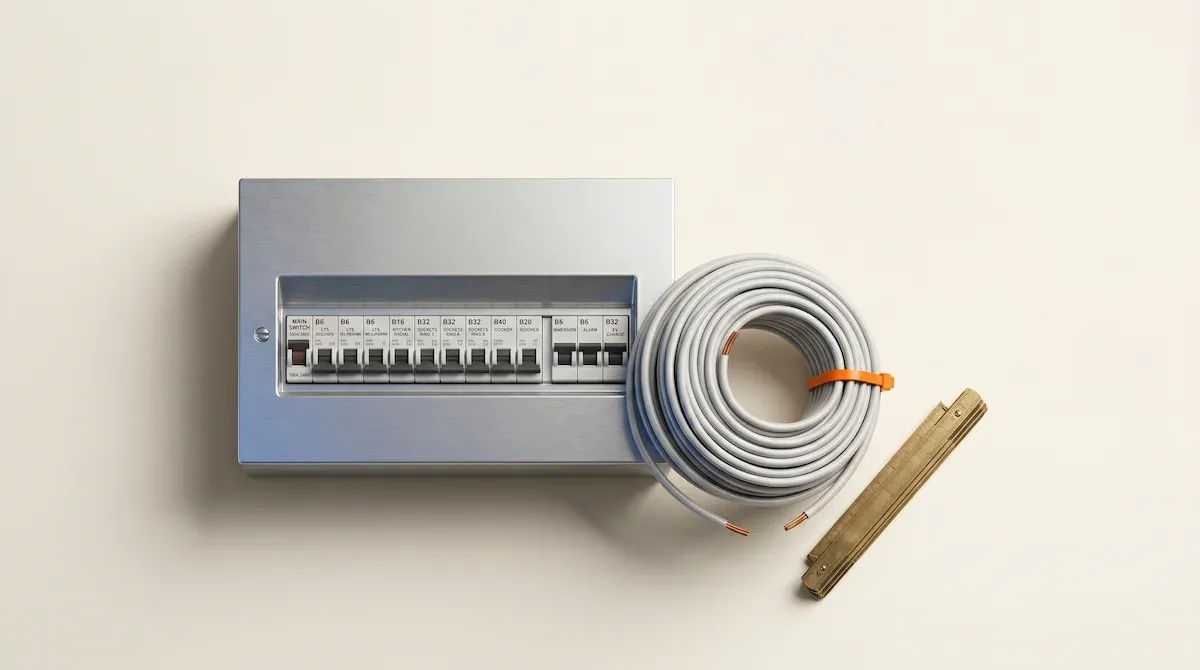
Last updated: 17 June 2026
A fuse box upgrade, properly called a consumer unit replacement, costs about £550 to £850 in London in 2026 for a typical three-bed home, fully installed and certified by a registered electrician [1]. Most straightforward jobs fall between £500 and £900, with small flats starting around £350 and large detached houses reaching £1,200 or more [1]. London labour runs roughly 15 to 30 per cent above the UK average, and prices vary noticeably between firms, so always get more than one written quote.
This guide breaks down prices by property size, the dual-RCD versus full-RCBO choice, what Part P requires, and the certificates you should receive.
A quick answer: consumer unit upgrade prices in London (2026)
| Property size | Typical circuits | London range, installed and certified |
|---|---|---|
| 1 to 2 bed flat | 6 to 8 | £350 to £550 |
| 3-bed terraced or semi-detached house | 8 to 12 | £550 to £850 |
| 4+ bed detached house | 12 to 16+ | £850 to £1,200+ |
These ranges come from a 2026 London contractor price guide and cover materials, labour and Part P certification through a competent person scheme [1]. They are guide figures rather than fixed prices, so check whether each quote includes VAT and compare like with like. Most straightforward jobs land between £500 and £900 and take four to eight hours [1]. If an EICR inspection is needed first, it is charged separately, so ask for that price when you book.
Consumer unit jobs are almost always quoted as a fixed price rather than by the hour, because the scope is predictable once the circuit count is known. As a sanity check, London electricians' day rates run about £350 to £450, and a board change is typically half a day to a full day's work [12].
What a fair fuse box quote should include
Before you accept a quote in London, check it covers the following. This is the most useful list to have in hand when you compare electricians:
- A fixed total price in writing, not a rough estimate. The scope is predictable once the circuit count is known, so a consumer unit job is normally quoted as a fixed price.
- The board type and number of ways. Dual-RCD (split-load) or full-RCBO, and how many circuits, so you are comparing like with like.
- A metal enclosure. Consumer units in homes must be non-combustible, which in practice means a metal enclosure, under Regulation 421.1.201 of BS 7671. A plastic unit does not meet the current standard [3].
- A surge protection device (SPD). An SPD has been required on most new domestic boards since the wiring regulations changed in September 2022. Confirm one is included, or that you have formally opted out [3].
- Earthing and bonding checked. The quote should confirm the main earthing and the bonding to your gas and water pipes will be checked and brought up to standard if needed. Missing or undersized bonding is common in older London homes and is a frequent extra cost; budget £150 to £600 if your property is over 30 years old.
- Testing and certification. A full test of the installation and an Electrical Installation Certificate (EIC), included in the price rather than charged as an add-on.
- Part P notification. The work is notifiable, so the price should include notification to Building Control and the compliance certificate that follows.
- Registration you can verify. The competent person scheme name and registration number, so you can check it on the NICEIC, NAPIT or ELECSA website before you accept [11].
- What happens if faults are found. Ask how the electrician handles defects uncovered during testing: a circuit that fails cannot be connected to the new board and certified, so agree the approach to remedial work before they start.
As a rule of thumb, get two or three written quotes for the same scope, and be wary of anyone who will not put a fixed price in writing or who cannot certify their own work.
What is a consumer unit upgrade?
A consumer unit, still widely called a fuse box, takes the incoming mains supply and splits it across the individual circuits in your home, with a protective device guarding each one. Modern units include residual current devices (RCDs) that switch a circuit off in milliseconds when they detect a fault, protecting you from electric shock.
Under Regulation 421.1.201 of BS 7671:2018, the 18th Edition Wiring Regulations, consumer units in homes must be made of non-combustible material or enclosed in a non-combustible cabinet, which in practice means a metal enclosure [3]. Regulation 411.3.4 also requires every domestic lighting circuit to have additional protection from a 30 mA RCD [3]. An upgrade replaces an out-of-date board with one that meets the current edition of the Wiring Regulations.
The most recent amendment, Amendment 4 (BS 7671:2018+A4:2026), was published on 15 April 2026, with a transition period running to 15 October 2026 [4]. For a standard consumer unit replacement, though, the requirements that drive the job are the metal enclosure and the surge protection device, the latter required on most domestic boards since September 2022 [3].
What affects the cost in London
- The number of circuits. More circuits mean more protective devices, more testing and more labour, which is why a large detached house can cost more than twice as much as a small flat [1].
- Dual-RCD or full-RCBO board. Once each circuit's individual RCBO is included, a full-RCBO board adds roughly £200 to £400 in materials over a dual-RCD setup, but it stops one faulty appliance from tripping several circuits at once [1].
- Surge protection. A surge protection device (SPD) has been required on most new domestic boards since the wiring regulations changed in September 2022, so check each quote includes one rather than treating it as optional [3].
- Earthing and bonding. Missing or undersized bonding to gas and water pipes is common in older London homes and must be put right before the work can be certified; allow £150 to £600 if your property is over 30 years old.
- Mains-wired smoke alarms. If these need fitting at the same time, allow £40 to £80 per alarm [1].
- Condition of the existing installation. Faults found during testing must be put right before the work can be certified.
- Access and the London premium. London electricians' day rates run about £350 to £450, roughly 15 to 30 per cent above the UK average [12].
- Timing. Emergency or weekend work typically carries a 25 to 50 per cent premium [1].
Dual-RCD or full-RCBO: which board should you choose?
A dual-RCD (split-load) board shares one RCD across a bank of circuit breakers, so a single earth-leakage fault can trip several circuits at the same time [5]. An RCBO board gives each circuit its own combined overcurrent and earth-leakage protection, so a fault isolates only the circuit responsible [5].
Suppliers strongly recommend the full-RCBO option where an EV charger, induction hob or solar PV system is being added [5]. Where equipment such as an EV charger or inverter can produce direct current components, Regulation 531.3.3 requires a Type A RCBO rather than the older Type AC device [3].
| Item | Typical London trade price (2026) |
|---|---|
| Dual-RCD consumer unit | £80 to £160 [1] |
| Full-RCBO board (unit only) | £150 to £250 [1] |
| Individual RCBOs | £8 to £18 each [1] |
| MCBs | £4 to £10 each [1] |
| Incidental materials | £20 to £50 [1] |
| Mains-wired smoke alarms (if required) | £40 to £80 per unit [1] |
Materials are only part of the bill: four to eight hours of labour at London rates accounts for most of the rest [1].
Part P: the rules you cannot skip
Installing a new or replacement consumer unit is notifiable work under Part P of the Building Regulations in England [6]. There are two compliant routes: an electrician registered with a competent person scheme, such as an NICEIC, NAPIT or ELECSA member, can self-certify and notify Building Control on your behalf, or you must notify your local building control body in advance and pay for them to inspect. Either way, a Building Regulations compliance certificate must be issued within 30 days of completion [6].
The statutory guidance sits in Approved Document P, Electrical Safety in Dwellings [7].
This is not a job to attempt yourself: the work involves the main incoming supply, it is notifiable by law, and the certification that follows cannot be issued retrospectively. It belongs to a registered electrician.
The certificates you should receive
A consumer unit replacement should leave you with two pieces of paper, and they are not interchangeable:
- An Electrical Installation Certificate (EIC). This certifies the new work and can only be issued by the registered electrician who designed and supervised it; another electrician cannot sign off the installation section retrospectively [8]. Missing EICs cause problems later: buyers' solicitors routinely request them and a gap can obstruct a sale [8].
- A Building Regulations compliance certificate, issued within 30 days of completion, confirming the work was notified under Part P [6].
An EIC is not the same as an EICR (Electrical Installation Condition Report), a periodic health check of the whole installation rather than a certificate for new work; landlords still need a satisfactory EICR regardless of any recent EIC [9].
When does a fuse box actually need replacing?
You should consider an upgrade if your existing board shows any of these signs:
- Rewireable (wire-in) fuses still in use [2]
- No RCD test button anywhere on the board [2]
- A wooden back board [2]
- Frequent RCD tripping [2]
- Scorch marks or a burning smell, which justify an urgent call to an electrician
- An age of more than 20 years
Having an old fuse box is not automatically illegal [2]. The most reliable way to find out whether yours needs replacing is an EICR. The report grades what it finds: C1 means danger present with a risk of injury, C2 means potentially dangerous, and both require remedial work; C3 is an improvement recommendation only, and a report can still be satisfactory with only C3 items [10].
How long does the job take, and what is included?
A typical London consumer unit replacement takes four to eight hours, and your electricity will be off for most of the working day [1]. A complete written quote should include:
- Removal and disposal of the old unit
- Installation of a consumer unit compliant with the current edition of BS 7671 [4]
- A clear statement of whether a surge protection device (SPD) is included
- Testing of the existing circuits before the new board is energised
- The Electrical Installation Certificate (EIC)
- Notification to Building Control and the compliance certificate that follows [6]
If testing uncovers wider problems with the wiring itself, the conversation may move from a board change to something larger; our guide to house rewire costs in London covers what that involves.
How to get a fair quote
- Check registration first. Confirm your electrician is registered with a competent person scheme; NICEIC, NAPIT and ELECSA are the principal operators for domestic work, and you can verify any contractor on their online directories or the Registered Competent Person Electrical website [11].
- Get at least two or three written quotes for the same scope of work, since prices vary noticeably between firms.
- Compare like with like. Make sure each quote states the board type (dual-RCD or full-RCBO), whether an SPD is included, whether smoke alarms are in scope, whether VAT is included, and that the EIC and Building Control notification are part of the price.
- Be wary of anyone who cannot certify their own work. If a trader suggests someone else can sign it off afterwards, walk away; that is not how an EIC works [8].
For the broader checks that apply to any trade, see our guide on how to find a trusted tradesperson in London.
Finding a trusted electrician in London
A consumer unit is the one piece of equipment that protects every circuit in your home, so the person who fits it matters more than the brand on the box.
Find a trusted local tradesperson on loacally, or browse local electricians directly. Every application is reviewed by hand before a tradesperson goes live on loacally, and the service is free for customers. For more on wiring, boards and certification, see the rest of our electrical guides.
Frequently asked questions
Is replacing a fuse box notifiable work under Part P? Yes. Installing a new or replacement consumer unit is notifiable work under Part P of the Building Regulations in England [6]. A registered electrician can self-certify and notify Building Control for you; otherwise your local building control body must be told in advance. A compliance certificate must be issued within 30 days of completion [6].
Can I replace my own consumer unit? No. The work is notifiable, it involves the main incoming supply, and only the registered electrician who designed and supervised the installation can issue the Electrical Installation Certificate; another electrician cannot sign it off retrospectively [8]. A registered electrician handles the safety, the certification and the Building Control notification in one visit [6][11].
What is the difference between an EIC and an EICR? An EIC (Electrical Installation Certificate) certifies new work, such as a consumer unit replacement, and is issued by the electrician who carried it out [8]. An EICR (Electrical Installation Condition Report) is a periodic inspection of the whole existing installation, priced separately from new work. Landlords need a satisfactory EICR regardless of any recent EIC [9].
Do I need a full-RCBO board, or is a dual-RCD board enough? Both can comply with the regulations, but they behave differently under fault conditions. A dual-RCD board shares protection across groups of circuits, so one fault can trip several at once; an RCBO board isolates only the faulty circuit [5]. Once each circuit's RCBO is included, the RCBO option adds roughly £200 to £400 in materials [1], and it is strongly recommended where an EV charger, induction hob or solar PV system is involved [5].
How long will my power be off? Plan for most of the working day. A straightforward replacement takes four to eight hours, and the supply is off for the bulk of that time while circuits are disconnected, transferred and tested [1]. Ask your electrician to confirm timings in the quote.
Sources
- Electrical Testing London - Fuse Box Upgrade Cost in London: 2026 Price Breakdown - https://www.electricaltestinglondon.co.uk/blog/fuse-box-upgrade-cost-in-london--2026-price-breakdown - 2026 (a contractor price guide; figures are guides, not fixed prices).
- Electrical4Less - Old Fuse Boxes: Risks, Rules and When To Upgrade - https://www.electrical4less.co.uk/2025/07/09/old-fuse-boxes/ - published 9 July 2025.
- IET - BS 7671 18th Edition FAQs: Consumer Units and Protective Devices - https://electrical.theiet.org/bs-7671-18th-edition-wiring-regulations/faqs/consumer-units-and-protective-devices-faqs/ - checked June 2026.
- NICEIC Shop - IET Wiring Regulations 18th Edition Amendment 4 (BS 7671:2018+A4:2026) - https://shop.niceic.com/products/iet-wiring-regulations-18th-edition-amendment-4-bs7671-2018-a4-2026 - 2026.
- Electrical4Less - RCBO Consumer Units vs Dual RCD: Why Electricians Are Making the Switch - https://www.electrical4less.co.uk/2025/08/04/rcbo-consumer-units-vs-dual-rcd-why-electricians-are-making-the-switch/ - published 4 August 2025.
- Gov.uk - Building work, replacements and repairs to your home - https://www.gov.uk/government/publications/building-work-replacements-and-repairs-to-your-home/building-work-replacements-and-repairs-to-your-home - checked June 2026.
- Gov.uk - Electrical safety: Approved Document P - https://www.gov.uk/government/publications/electrical-safety-approved-document-p - checked June 2026.
- Which? Trusted Traders - Electrical installation regulations and the risk of unregistered electrical work - https://trustedtraders.which.co.uk/articles/electrical-installation-regulations-don-t-get-left-with-unregistered-electrical-work/ - updated November 2025.
- NICEIC - Help Hub: Householders and Landlords - https://niceic.com/the-niceic-help-hub/householders-and-landlords-help-hub/ - checked June 2026.
- Gov.uk - Electrical safety standards in the private and social rented sectors: guidance - https://www.gov.uk/government/publications/electrical-safety-standards-in-the-private-and-social-rented-sectors-guidance/electrical-safety-standards-in-the-private-and-social-rented-sectors-guidance - published 1 November 2025.
- Gov.uk - Competent person scheme: current schemes and how schemes are authorised - https://www.gov.uk/guidance/competent-person-scheme-current-schemes-and-how-schemes-are-authorised - checked June 2026.
- Total Skills UK - Electrician day rates - https://www.totalskills.co.uk/guides/electrician-day-rates - updated 2026.
Need an electrician in London?
See who’s nearby, compare clear prices, and book a visit in minutes.
Keep reading
Signs You Need to Rewire Your House: A London Homeowner's Guide (2026)
How to tell if your London home needs rewiring in 2026: the urgent warning signs, the signs to get checked, what an EICR tells you, and why a registered electrician must do the work.
EV Charger Installation Cost in London (2026 Prices)
A home EV charger in London costs around £900 to buy and install in 2026, with most jobs between £500 and £1,200. This guide tiers the price by cost driver, explains the Gov.uk grants of up to £500 for flats, renters and on-street parking, covers the Part P and safety rules, and shows what a fair quote includes.

EICR Explained: What an Electrical Safety Certificate Costs in London and When You Need One (2026)
A clear 2026 guide to the EICR, the electrical safety certificate. What it covers, who legally needs one in London, what it costs, what the C1 to C3 codes mean and how to find a registered electrician.